


Get clean data from construction drawings via API.
Upload complex construction documents and get clean, citable JSON. Plangrep extracts sheets, regions, tables, and source text so you can build drawing intelligence without building a parser from scratch.
$0.20 per sheet uploaded. No egress costs.
Trusted by teams building the next generation of construction software.
- BuiltSpace
Construction PDFs weren't built for machines.
A set of plans is hundreds of pages of dense drawings, tables, and notes with unique layouts per project. The data your product needs is scattered across sheets, updated and relocated from one revision to the next, and labeled by conventions that vary firm to firm. So teams write brittle OCR scripts, hand-crop regions, and babysit edge cases instead of shipping with consistent data across all projects.
Structure, not just text.
- 01Sheets
Every drawing sheet, parsed with its number (A101), name (FIRST FLOOR PLAN), page, and discipline. The plan set becomes an addressable index. Individual files split automatically to PDF and PNG.
- 02Drawing regions
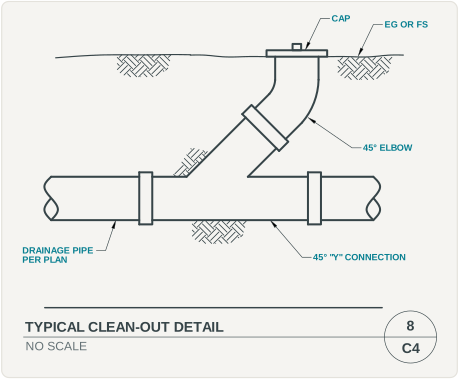
Details, callouts, legends, schedules, and plan views detected as discrete regions — each with a bounding box, a type, and extracted text. Ask for detail 3 on M002 and get exactly that.
- 03Schedules & specs
Door schedules and equipment tables come back as real tabular JSON. Spec sections are parsed out with numbers and titles (e.g. 064100 - Architectural Wood Casework) and broken down by facet (e.g. SUBMITTALS, PRODUCT DATA, EXECUTION).
- 04Citable artifacts
Sheet renders, region crops, and markdown text — so your AI can efficiently view the drawings and cite exact sources for its work.
Grounded answers need grounded sources.
Use source-search for semantic search across the processed project set, then source-text to read the exact evidence behind a selected hit. Upload the files, wait for processing, then ask in plain English — Plangrep returns ranked hits with snippets and URIs that point back to the source record. For drawing sheets and regions, responses also include image artifacts for the exact visual context.
curl -sS "$PLANGREP_API/api/open/v1/projects/$PROJECT_ID/source-search" \
  -H "Authorization: Bearer $PLANGREP_API_KEY" \
  -H "Content-Type: application/json" \
-d '{"query":"roof penetration detail","maxHits":5}'curl -sS "$PLANGREP_API/api/open/v1/projects/$PROJECT_ID/source-text" \
-H "Authorization: Bearer $PLANGREP_API_KEY" \
-H "Content-Type: application/json" \
-d '{"sourceCatalogUri":"source-catalog://..."}'From PDF to API in three steps
- 1
Upload
Create a project, drop in files (10 GB per job). Multipart, signed, or base64.
- 2
Process
Plangrep parses sheets, regions, schedules, and specs, then vectorizes. Track it by polling or webhook; most jobs finish in 10–15 min.
- 3
Query
Hit the API for normalized results, artifacts, and semantic search. Build your product on top.
Consumption-based, with a ceiling you set.
Buy credits up front. Pay only for pages that process successfully. Unused credits roll over.
≈ 1,333 drawing pages · or 13,333 document pages
$0.015 per credit · 25% off list
Billed monthly · cancel anytime
Not sure what a credit is? Start from your drawings.
Tell us what you actually have. We'll tell you what it costs.
A typical bid set runs 100–200 drawing pages. At 10 credits per drawing page, that's 1,000–2,000 credits per set — so the $200 plan handles roughly 7–13 full sets a month.
Free
Enough credits to parse a real drawing set end to end.
- 1,000 credits (~100 drawing pages)
- Full API access — no feature gates
- No credit card required
Need more than $500/mo?
Higher volume, dedicated support, and negotiated per-credit rates.
- Volume rates below $0.010 / credit
- Higher concurrency limits
- Extended result retention
Credits never expire while your plan is active and roll over month to month.
Failed pages aren't charged. Reserved-but-unused credits are released back to your balance.
Pricing questions
Stop parsing PDFs by hand.
Get an API key and pull structured data from your first drawing set today.